By Anas · Updated October 9, 2026 · 11 min read
Interior Design Styles: A Guide to 18 of Them
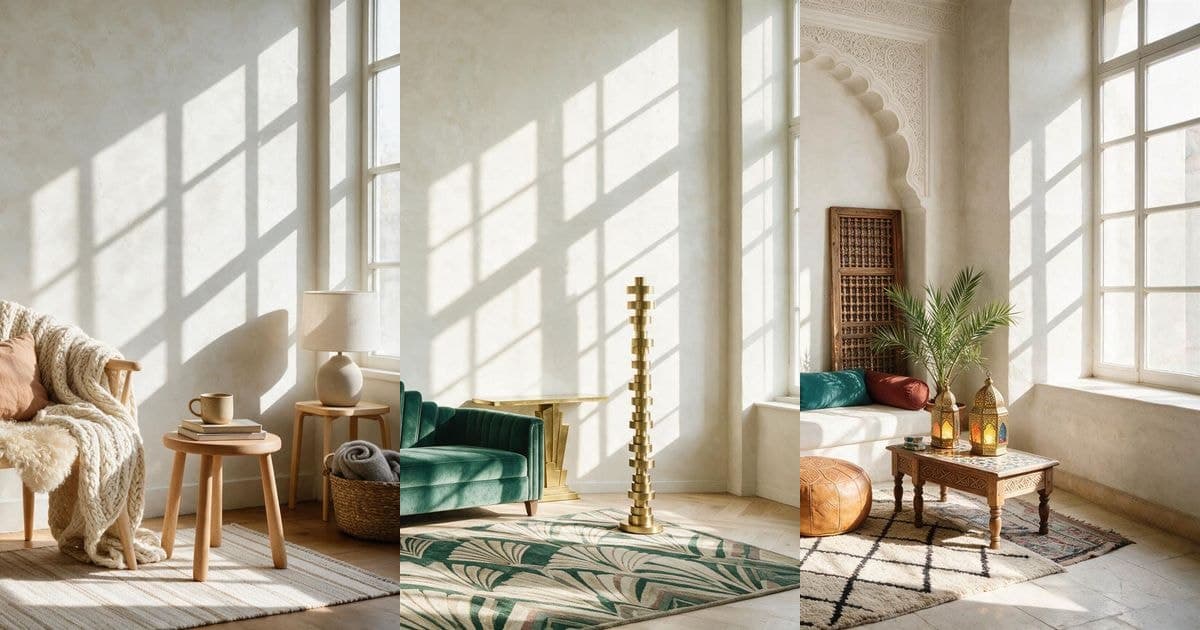
An interior design style is a repeatable set of decisions about four things: colour, material, shape and light. Every named style you have heard of, from Art Deco to cottagecore, is shorthand for one particular combination of those four. Learn to read them separately and the whole vocabulary stops being intimidating, because you can borrow one decision from a style without having to adopt the entire room.
Below are eighteen styles we have written full guides for, what each one really means, and the questions people actually ask before they pick one.
What are the main interior design styles?
The main interior design styles fall into four rough families: historical movements with a fixed date, such as Art Deco and mid-century modern; regional traditions like Scandinavian, Japandi, Moroccan and coastal; internet-born aesthetics including cottagecore and dark academia; and organising principles rather than looks, which is what minimalism, maximalism and eclectic really are. A style from one family sits happily beside one from another. A room does not have to pick a lane.
Here is every style guide on this site, with the one thing that actually defines each.
- Japandi: Japanese restraint plus Scandinavian warmth. Low furniture, natural wood, almost no pattern.
- Scandinavian and hygge: Pale wood, high-reflectance walls, and lighting split into many small warm sources.
- Minimalist: Subtraction as the method. Fewer objects, longer sightlines, one material doing the talking.
- Maximalist: Deliberate abundance held together by a repeating colour, not a free-for-all.
- Mid-century modern: Tapered legs, teak and walnut, low horizontal lines. A real historical period, not a mood.
- Art Deco: Geometry, symmetry, lacquer and brass. Glamour built out of straight lines and arcs.
- Modern farmhouse: Rustic texture with modern proportions. Works when the texture is real and the palette stays quiet.
- Boho: Layered textiles and collected objects, with enough empty floor to let it breathe.
- Coastal: Light, air and washed-out tone. The grown-up version leaves out the anchors and rope.
- Cottagecore: Floral, handmade and softly worn. A named internet aesthetic with a traceable start date.
- Dark academia: Books, lamplight and deep tone. Moody on purpose, and it needs more light sources than people expect.
- Gothic: Dark walls done properly, which is a lighting problem long before it is a paint problem.
- Moroccan: Bold pattern and carved detail, kept calm by holding the palette to a narrow range.
- Biophilic: Plants, daylight and natural material treated as structure rather than decoration.
- Dopamine decor: Saturated colour chosen for how it makes you feel rather than how it photographs.
- Eclectic: Mixing styles on purpose, using one shared constraint to stop it reading as clutter.
- Warm modern: Modern shapes with warm materials. The compromise most people are actually looking for.
- Light and airy: High light-reflectance surfaces, low contrast, and restraint about how much sits on the floor.
What is the difference between modern and contemporary interior design?
Modern is a fixed historical period and contemporary means whatever is current, which is why the two words are not interchangeable even though shops use them as if they were. Modern design descends from the Bauhaus, the German school Walter Gropius founded in Weimar in 1919 and which closed in 1933 after moving first to Dessau and then to Berlin. Its ideas hardened into a look: exposed structure, no applied ornament, function stated plainly.
Contemporary has no date attached. It is a moving target, and a contemporary room from 2010 already looks dated in a way a genuinely modern one does not. So if someone offers you a contemporary scheme, ask which year they mean. And if you want the look most people picture when they say modern, you almost certainly mean mid-century modern, which is a narrower and much more specific thing.
What is the difference between an interior design style and a decorating style?
A design style includes things bolted to the building and a decorating style only includes things you can carry out of it. That distinction matters enormously if you rent, because a large share of what makes a room read as a particular style is fixed: the floor, the window shape, the ceiling height, the kitchen carcasses, the trim profile.
The decorating half is where nearly all of the effect actually lives anyway. Textiles, lighting, wall colour where your lease allows it, and what sits on the surfaces will carry a style further than any structural change. But it is worth being honest that a rented flat with the wrong floor will never fully be one thing, and chasing the missing half is how people spend a lot of money for a small result.
The renter version of this, with the choices that come back out again at the end of a tenancy.
Read: small bedroom ideas for renters →How do I know which interior design style is mine?
Look at what you already own rather than at what you save. The gap between the two is usually wide, and it is the most useful diagnostic there is: people pin high-contrast dramatic rooms and then live entirely in soft neutral ones, or the exact reverse. Your existing furniture, the colours in your wardrobe, and the objects you have not thrown away in ten years are a far more honest sample than a mood board is.
Then check the four decisions. Do you want colour to do the work, or material? Straight lines or curved ones? One big light source or several small ones? Warm surfaces or cool ones? Answer those four and the style name usually falls out on its own. If it doesn't, what is my home decor style works through the same question using the things you already own.
A short quiz, no sign-up, and it names the style plus the two it borders on.
Take the free style quiz →Can you mix two interior design styles in one room?
Yes, and the reliable method is to let the two styles disagree about shape while agreeing about colour. A mix reads as deliberate when something is held constant and as accidental when nothing is. Colour is the easiest constant to hold, which is why the 60-30-10 convention survives: roughly 60 percent of a room in one dominant colour, 30 percent in a secondary, and 10 percent in an accent.
Keep both styles inside that split and a carved Moroccan side table can sit beside a plain Scandinavian sofa without the room arguing with itself. Break the split and those same two pieces look like they arrived from different houses. That is the whole of eclectic design, and it is a discipline rather than a licence.
Which interior design styles work best in a small room?
The styles that suit small rooms are the ones that control contrast and reflectance, which in practice means light and airy, Scandinavian, Japandi and most minimalist schemes. Light Reflectance Value is the number to watch. It runs from 0 to 100, every major paint brand publishes one per colour, and a high-LRV wall keeps a small room open while a low one needs extra lamps to stop it closing in.
Floor space is the other half of it. Main walkways through a room want about 36 inches and secondary gaps between pieces about 30, and those clearances do not shrink just because a room is small. They are the first thing a heavily layered style breaks.
The full rulebook we apply, with each clearance attributed to the body that publishes it.
Read the method →Which interior design styles are genuinely new?
Three styles on this page were born online within the last decade and have documented start dates, which almost no older style does. Cottagecore was named on Tumblr, where the user gardengnomeprince posted the earliest known cottagecore mood board on 25 April 2018, before the tag moved to Instagram and TikTok in 2019. Dark academia appeared on Tumblr by 2014, reached Instagram around 2017, and then surged during 2020 when a great many people were shut indoors with their books.
Dopamine decor is newer still and arrived from fashion before it reached rooms. What is genuinely different about all three is that they were named from the inside, by the people using them, which older styles never were.
Do the older style names still mean anything?
They do, but hardly any of them were named at the time, which is exactly why the labels feel slippery. Art Deco takes its name from the 1925 Exposition Internationale des Arts Decoratifs et Industriels Modernes in Paris, and yet nobody called the style Art Deco until 1966, when the Musee des Arts Decoratifs held a retrospective called Les Annees 25.
Mid-century modern is the same story. The furniture was made through the 1950s and 1960s, but the phrase was only fixed as the name of a movement by Cara Greenberg, in her 1984 book Mid-Century Modern: Furniture of the 1950s. Even hygge is recent as an English word, shortlisted for Oxford Dictionaries Word of the Year in 2016, where it lost to post-truth.
A style name is nearly always a label applied later, by someone looking back.
| Style | Where the name comes from | The giveaway |
|---|---|---|
| Art Deco | The 1925 Paris exposition, but only named in 1966 | Symmetry, arcs, brass and lacquer |
| Mid-century modern | Cara Greenberg's 1984 book about 1950s furniture | Tapered legs and low horizontal lines |
| Modern | The Bauhaus, 1919 to 1933 | No applied ornament, structure left visible |
| Scandinavian and hygge | Hygge reached the Oxford shortlist in 2016 | Pale wood and many small warm lights |
| Cottagecore | Tumblr, 25 April 2018 | Floral, handmade, softly worn |
| Dark academia | Tumblr by 2014, mainstream in 2020 | Books, lamplight, deep tone |
What does it cost to decorate in a particular style?
The cost of a style is decided almost entirely by how much of it is fixed to the building. Repainting and swapping textiles is cheap in every style on this page. Changing a floor, a trim profile, kitchen fronts or a window shape is not, and those are exactly the elements that carry Art Deco, farmhouse and traditional schemes.
So here is the limitation worth knowing before you start. Styles that live in the removable layer, like boho, dark academia or Scandinavian, can be reached on a small budget. Styles that live in the architecture cannot be faked cheaply, and they usually look worse when the attempt is made. Pick a style whose defining decisions sit in the layer you are actually allowed to change.
What decorators and designers really charge, and the difference between the two roles.
Read: how much does an interior decorator cost? →How do I test a style before committing to it?
Test a style on the two things that are hardest to undo, which are wall colour and light. Paint a large sample directly onto the wall rather than judging a chip in your hand, and look at it in both morning and evening light, because a colour with a low LRV can land two shades darker than the swatch suggested.
Then check the light itself. Rough working targets from lighting practice are around 20 lumens per square foot for ambient light in a living space, and about 50 per square foot on a work surface. Most style failures people blame on the style are really lighting failures. Art placement helps too, and galleries centre work at about 57 inches from the floor, which is average eye height.
Free and no sign-up: upload one photo and see your own room redesigned in a style, keeping the furniture you already own.
See my room in a new style free →Quick answers
What are the most popular interior design styles right now?
Japandi, warm modern and the softer end of Scandinavian are the ones most people ask for, with maximalism and dopamine decor pulling in the opposite direction. Popularity moves much faster than rooms do, which makes it a poor reason to choose. The style that matches furniture you already own will cost less and last longer than the one trending this season.
How many interior design styles are there?
There is no fixed number, because styles are labels applied by writers and dealers rather than defined by any authority. Most guides list somewhere between 15 and 40 of them. This page covers 18 that are distinct enough to be worth telling apart, and several of those deliberately overlap.
What is the difference between modern and contemporary?
Modern is a fixed historical period descending from the Bauhaus, which ran from 1919 to 1933, while contemporary simply means whatever is current. That is why a contemporary room dates and a genuinely modern one does not. When most people say modern about furniture, they mean mid-century modern.
Can I mix interior design styles in one room?
Yes, provided something stays constant across both. Colour is the easiest constant to hold, and the 60-30-10 split is the usual way to hold it: about 60 percent dominant, 30 percent secondary, 10 percent accent. Let the two styles differ in shape and material while agreeing on palette, and the mix reads as intentional.
Which interior design style is best for a small room?
Light and airy, Scandinavian and Japandi suit small rooms best, because all three use high light-reflectance surfaces and low contrast. Light Reflectance Value runs from 0 to 100 and every major paint brand publishes it per colour. Whichever style you pick, keep about 36 inches on main walkways, because that clearance does not shrink with the room.