Journal · By Anas · Updated September 28, 2026 · 6 min read
Light & Airy Interior Design — Bright, Open Room Guide
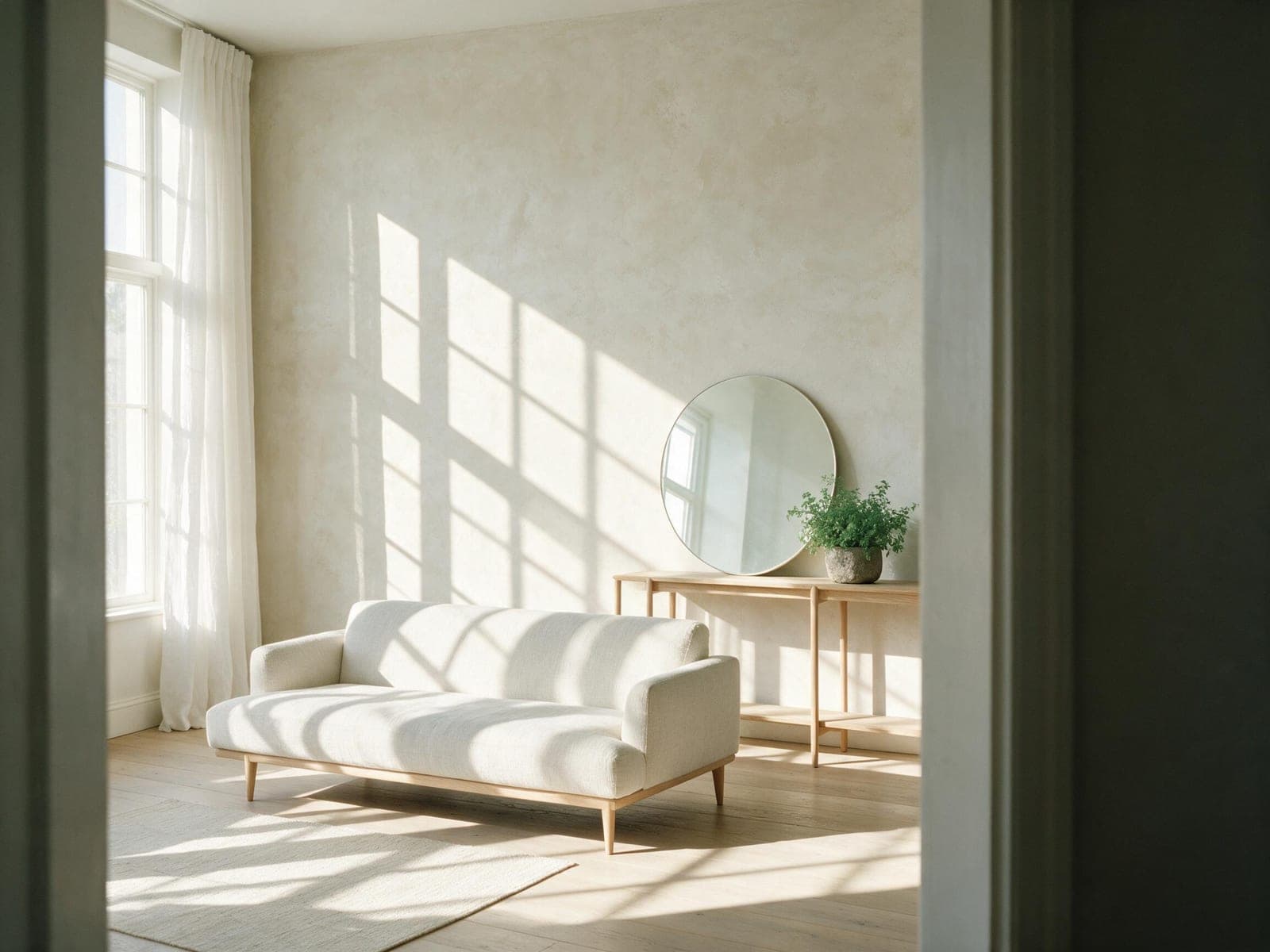
Some rooms feel like they're holding their breath. Light and airy design is how you let a space exhale — and it is less about a trend than about two measurable things: how much daylight the room keeps, and how much visual weight is sitting in it. Get those right and almost any room opens up, including a small one and including a north-facing one.
The number that actually decides it: LRV
Most guides tell you to paint the walls white and stop there, which is why so many rooms end up pale and still somehow flat. The useful measure is LRV, or Light Reflectance Value. It runs from 0, absolute black, to 100, pure white, and it describes how much light a colour bounces back into the room instead of swallowing. Every major paint brand publishes it, usually in the small print on the colour page.
As a working rule: an LRV in the 80s reads as genuinely light, the 60s and 70s read as soft and warm rather than bright, and anything below about 50 will absorb daylight no matter how big the window is. Here are three whites with their published figures, so you can see how narrow the useful band actually is.
| Colour | Brand and code | LRV |
|---|---|---|
| Chantilly Lace | Benjamin Moore OC-65 | 92.2 |
| White Dove | Benjamin Moore OC-17 | 83.2 |
| Alabaster | Sherwin-Williams SW 7008 | 82 |
One caveat worth more than the number itself: LRV tells you how much light comes back, not what colour that light is. A high-LRV white with a grey undertone in a north-facing room will read cold and slightly blue, which is the opposite of airy. Match the undertone to the light your room actually gets, then use LRV to decide how bright to go.
Keep the palette pale — and, more importantly, tonal
Bright whites, soft creams and the palest woods reflect light and make walls feel further away. But the part that does the real work is staying tonal: when the walls, floor, textiles and large furniture all sit in the same light family, the eye travels across the room without stopping, and the space reads as one continuous volume.
This is why white walls alone often disappoint. Set a dark sofa and a dark rug against brilliant white and you have built maximum contrast, and every hard edge tells the eye where the room stops. Evenness is what makes a space feel large — not brightness on its own.
Choose low, leggy furniture
Furniture on visible legs lets light and floor run underneath it, and the amount of visible floor is one of the strongest cues your eye uses to judge how big a room is. A skirted sofa sitting flush to the ground hides that floor and reads heavier than an identical sofa raised on legs. Keep backs low where you can, too, so you can see across the room rather than into a wall of upholstery.
Torn between airy brightness and something cozier? Seven quick questions will tell you which style keeps winning your instincts.
Take the free Room Style Quiz →Let the windows work
- ·Swap heavy curtains for sheer, floor-length panels — the fabric should just touch the floor, not pool on it
- ·Mount the rod close to the ceiling rather than to the top of the frame, so the window reads full-height
- ·Extend the rod well past the frame on both sides, so open curtains stack against wall instead of glass
- ·Keep sills clear — a row of objects on the sill blocks daylight at exactly the point it enters
- ·Clean the glass, which sounds trivial and is the cheapest brightness gain available
Mirrors help, but placement decides whether they do anything. A mirror opposite or adjacent to a window bounces daylight deeper into the room. A mirror facing a dark corner or a cluttered wall simply doubles the dark corner. Before you hang one, stand where it will go and look at what it will be reflecting.
If your room faces north
North-facing rooms get steady, indirect, slightly cool light and never any direct sun, which is why they can feel grey even when they are not dark. The instinct is to reach for the coolest, cleanest white available; it usually makes things worse, because you are adding cool to cool.
Lean the other way instead. Choose a white with a soft warm undertone, keep the LRV high so you are not also losing light, and use warm bulbs rather than daylight-temperature ones — the bulb colour changes the room more cheaply than the paint does. Then bring in one or two genuinely warm materials, oak or a wool throw, to give the light something warm to reflect off.
Edit, don't fill
Airy rooms breathe because they aren't packed. Clear the floor first — floor clutter costs you more perceived space than anything on a wall — then keep surfaces mostly open and leave a little deliberate emptiness. A few well-placed pieces with space around them always feel lighter than a room filled edge to edge.
Love this look but wish it came with a little sea air? Coastal is light and airy's beach-house sister.
Read: Coastal Style Guide →See your room, opened up
When someone wants a room to feel more spacious and bright, this is the direction RoomCalm reaches for. Upload a photo, tell us you want it to feel spacious, and watch your room open up — with a coach note on what to clear first.
Free, no sign-up, and it keeps your real room and furniture instead of inventing a showroom.
See my room, opened up →For the walls: eight pale prints that never fight the light, the paint codes that keep them warm, and the hanging guide.
The Light & Airy Kit — 8 printable prints, $14 →Quick answers
What is light and airy interior design?
Light and airy interior design is an approach that keeps as much daylight in a room as possible and carries as little visual weight as possible: pale, tonal surfaces, sheer window treatments, furniture raised on legs, and floor you can see. It's a goal more than a fixed style, so Scandinavian, coastal and Japandi rooms can land there. Two levers do the work: how much of the incoming light survives the surfaces it hits, and how much bulk sits in the space. Here's the part that trips people up. It isn't whiteness that opens a room, it's evenness, so a pale sofa on a pale rug reads bigger than a dark sofa against bright white walls, and you don't have to empty the room to get there. The honest limit: no palette can manufacture daylight a room doesn't get, and a north-facing room needs warm whites, not more white.
What LRV should I look for in a light and airy room?
Look for an LRV in the 80s for walls if you want the room to read as genuinely bright. LRV — Light Reflectance Value — runs from 0 for absolute black to 100 for pure white, and it tells you how much light a colour throws back into the room rather than absorbing. Alabaster (Sherwin-Williams SW 7008) sits at 82 and White Dove (Benjamin Moore OC-17) at 83, which is the band most designers reach for when the brief is 'open this up'.
How do I make a dark north-facing room feel brighter?
Use a warm white rather than a cool one, because a north-facing room already receives cool, indirect light and a grey-leaning white will turn it flat and blue. Pick a white with a soft yellow or red undertone, keep the window dressing sheer and mounted high, and add warm-toned bulbs rather than daylight-temperature ones. Fighting the light's colour rarely works; leaning against it does.
Do white walls always make a room look bigger?
No — and this is the most common mistake in this whole style. White walls only open a room up when the rest of the room stays in the same light family. Put a heavy dark sofa and a dark rug against bright white walls and you have created maximum contrast, which chops the room into pieces and makes it read smaller. Tonal beats bright: it is the evenness that does the work, not the whiteness.
What curtains make a room look taller?
Sheer, floor-length panels mounted close to the ceiling rather than to the top of the window frame, and extended well past the frame on each side. Mounting high draws the eye up and makes the window appear to run the full height; extending wide means the fabric stacks against wall rather than glass, so you lose almost no daylight when they are open.
Is light and airy the same as Scandinavian or coastal?
They overlap but they are not the same. Light and airy is a goal — maximum daylight, minimum visual weight — and it can be executed in several styles. Scandinavian is one specific way of reaching it, with pale woods and layered textiles. Coastal is another, with cooler blues and more texture. You can also get there in a Japandi room, which is the warmest of the three.