Journal · By Anas · Updated August 21, 2026 · 6 min read
What Is Maximalist Interior Design? A Clear 2026 Guide
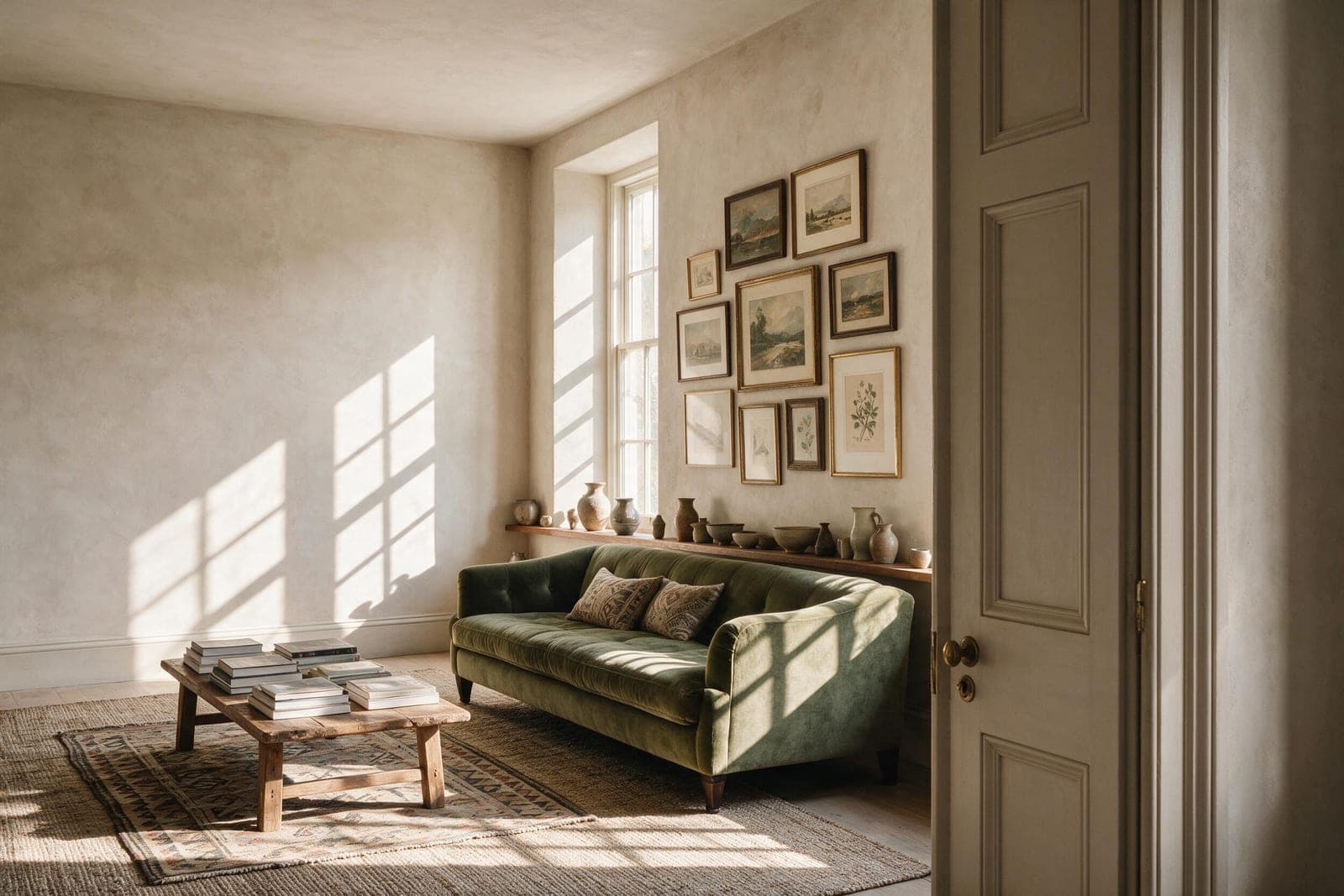
Maximalist interior design is the philosophy that more is more: layered colors, mixed patterns, full walls, and shelves that show your personality instead of hiding it. It is the loud, joyful opposite of the beige-grey minimalism that ruled the last decade. But here is the part nobody tells you: the difference between a maximalist room and a messy one is not the amount of stuff. It is whether the stuff was chosen. This guide covers what maximalism actually means, the three rules that keep it from tipping into chaos, and a way to test the style on your own room without spending anything.
What does maximalist interior design actually mean?
Maximalism is abundance with intention. A maximalist room layers color on color, pattern on pattern, and object on object — but every layer was picked by someone with a point of view. Think of a Victorian parlor, an art deco interior with its lacquer and brass, a Parisian apartment where the gallery wall took twenty years to grow, or the 'dopamine decor' rooms all over social media. Different eras, same idea: a room is a self-portrait, and a blank room is a blank portrait.
What maximalism is not: hoarding with confidence. It is not keeping everything, saying yes to everything, or filling every surface because empty space feels like a mistake. A maximalist room has more things than a minimalist one — but it has just as much discipline. The discipline is simply pointed at a different goal.
What is the difference between maximalism and clutter?
Maximalism is a collection. Clutter is a backlog. Every object in a true maximalist room could defend itself in one sentence: I love it, it means something, it earns its spot. Clutter is the stuff that stayed because nobody ever decided about it — the cable basket, the chair that collects clothes, the shelf of things you stopped seeing years ago.
Here is a test you can run tonight: stand in your fullest room and point at five random objects. If you can say why each one is there — not how it arrived, but why it stays — you are closer to maximalism than you think. If most answers are 'no reason, it just ended up there,' the room is not maximalist yet. It is waiting for an edit.
What are the rules of maximalist design?
Three disciplines separate a room that reads as a gallery from one that reads as a garage sale — and they are why two rooms with identical objects can feel completely different:
- ·Repeat a color thread. Pick two or three anchor colors and echo them across the room — emerald in the sofa, again in a vase, again in three book spines. Repetition tells the eye this is deliberate.
- ·Group, don't scatter. Ten frames on one wall is a gallery; ten frames spread around the house is noise. Collections displayed together read as intention. The same objects scattered read as mess.
- ·Keep one breathing point. Even the boldest room needs one calm surface or one quiet wall — a pause that makes everything else louder. Rooms with no rest don't feel rich; they feel tiring.
Maximalism vs eclectic vs cluttercore — what's the difference?
These three get mixed up constantly. Maximalism is about abundance held together by color and pattern discipline. Eclectic style is about mixing eras and styles — a mid-century chair beside a baroque mirror — and an eclectic room can actually be quite sparse. Cluttercore is a social-media aesthetic that celebrates the overflow itself: every surface full, on purpose, as the point. It photographs charmingly. Living in it is another question — most people who try cluttercore discover they wanted maximalism with its three disciplines, not the overflow.
How do you start a maximalist room without buying anything?
Shop your own house. Walk every room with a box and take everything you genuinely love — the books, the inherited plates, the art you never hung, the souvenirs hiding in drawers. Bring it all into one room. Then build up from love instead of editing down from excess: hang the art salon-style on one wall, stack the books horizontally in piles, group the ceramics on a single shelf, layer the small rug on top of the big one. Most people own a maximalist room already. It is just distributed across cupboards.
Not sure whether you're a maximalist or you just miss color? Find your actual style in two minutes — no forms, no email.
Take the free Room Style Quiz →Can a maximalist room still feel calm?
Yes — and the proof is centuries old. Moroccan interiors layer pattern on pattern on pattern, yet a riad feels like an exhale, not a headache. The trick: everything shares a warm undertone, and the patterns are geometric and repeated, so the eye finds order inside the abundance. If your layers share an undertone, a full room reads as warm. If they fight, even a half-empty room reads as noise.
See how pattern-heavy design stays calm — the rules are older than the trend.
Read the Moroccan style guide →The neighbouring question: maximalism is about quantity, eclectic is about variety of source. Here is the line, and the threads that hold a mix together.
Read the eclectic design guide →Is maximalism still in style in 2026?
The pendulum is swinging its way. After a decade of grey sofas and empty walls, people are re-discovering rooms with personality — that is what the whole dopamine-decor wave is about. But the honest answer is that trend cycles matter less here than anywhere else in design: a room built from things you already love never expires, because it was never built from a catalog in the first place. That is the maximalist bet, and it is a good one.
Curious what your own room looks like with more personality? Upload a photo and see it restyled in seconds — free, no sign-up.
See your room, bolder — free →Quick answers
Is maximalism the opposite of minimalism?
In spirit, yes: minimalism removes things until a room feels calm, maximalism adds things until a room feels personal. But both fail the same way — without intention. A cold empty room and a chaotic full room are the same mistake in opposite directions.
Is maximalist decor expensive?
No — it is one of the cheapest styles to build. Maximalism favors thrift finds, inherited pieces, and collections that grow over years. Time does the work money usually does.
What colors work in a maximalist room?
Almost any, if you repeat them. Pick two or three anchor colors and echo them around the room. Jewel tones like emerald, ruby, and brass are popular because they layer beautifully in warm light.
Can renters do maximalist design?
It is arguably the most renter-friendly style: maximalism lives in objects, art, textiles, and lamps — not in walls, floors, or renovation. Everything comes with you when you move.