Journal · By Anas · Updated August 22, 2026 · 8 min read
Buying Furniture on Facebook Marketplace — Rules to Know
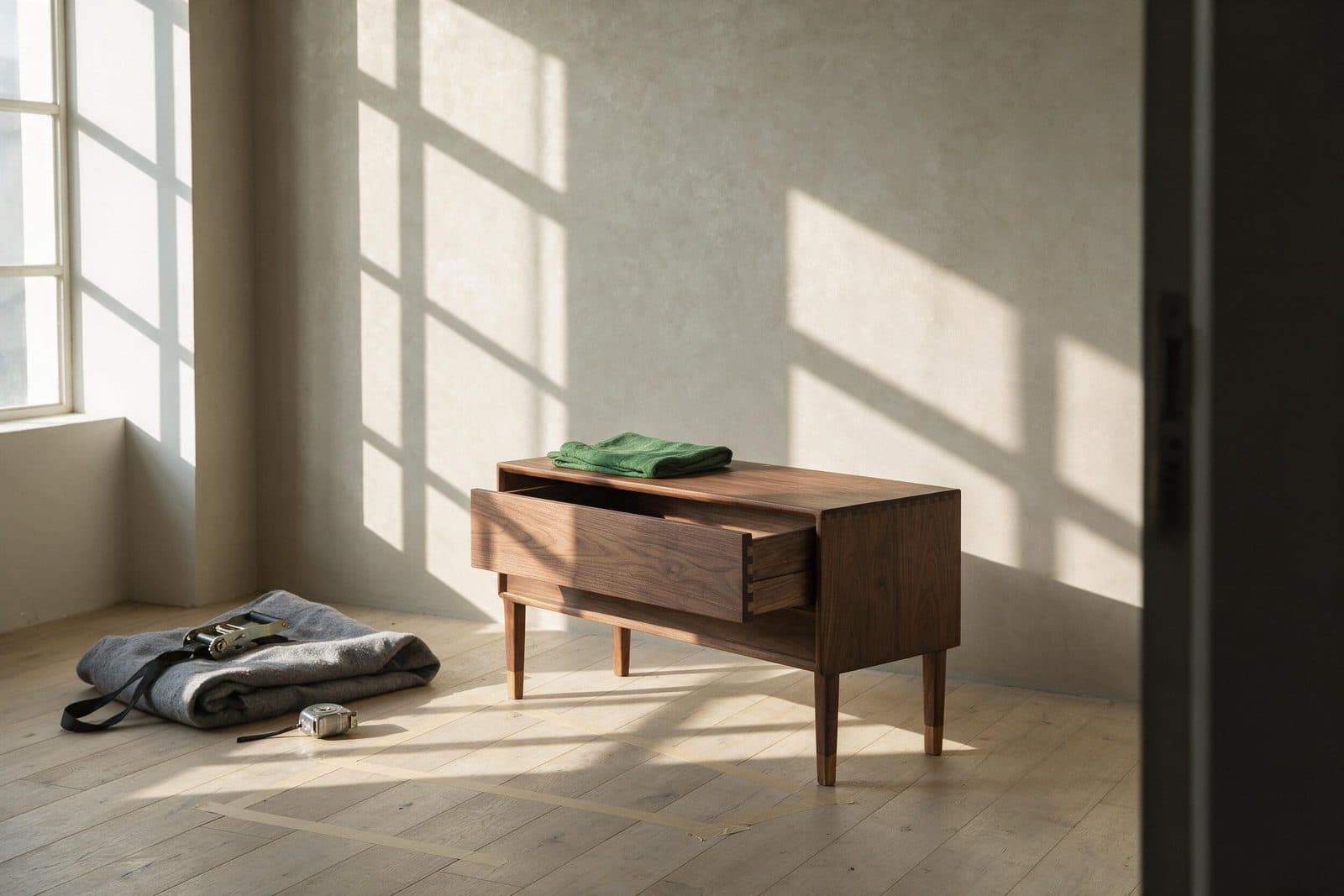
The good stuff on Marketplace goes fast. The bad stuff sits there for months, photographed in a dark hallway, looking like a bargain. Learning to tell them apart from your own sofa is the whole skill, and it is mostly unglamorous: reading the photos properly, telling solid wood from a printed picture of wood, asking three questions that save a wasted drive, and knowing whether the thing will get through your door before you agree to a time. None of it takes long. It just has to happen before you send "is this still available".
How do you buy furniture on Facebook Marketplace without getting burned?
Judge the piece from the photos, get the dimensions in writing, check it fits your room and your doorway, then inspect it in daylight before any money changes hands. Nearly every regretted Marketplace buy fails on one of four things: it was a different size than it looked, it was veneer pretending to be timber, it smelled, or it would not go up the stairs. All four are avoidable before you leave the house.
Read the photos like a surveyor, not a shopper
Marketplace photos are honest by accident. Nobody is styling a garage. That works in your favour, because what you are looking at is roughly what will arrive, and the flaws are usually in frame if you actually look for them.
Two tells matter most. If every photo is taken from the same angle, assume there is a reason the other side is not shown. And if the piece is photographed outdoors or in a garage, it has already been moved once, which tells you it comes apart or two people can lift it.
So ask for more. Message for close-ups of a drawer pulled out, the back panel, one corner, and the underside. A seller who sends four photos within the hour is usually the seller who will also be there when they said they would.
How can you tell if furniture is solid wood or veneer?
Look at the edges and the end grain. On solid wood, the grain running across the top carries on around the edge and down the side, because it is one piece of tree. Veneer over particleboard gives itself away with a hairline seam at the edge, a grain pattern that repeats identically on two different panels, or a chipped corner showing a pale crumbly core underneath. One close photo of a corner usually settles it.
Veneer is not automatically bad, and plenty of well-made vintage furniture uses it over a solid frame. The problem is chipboard with a photograph of oak glued to it, sold at solid-oak money.
- ·Drawers joined with dovetails or finger joints rather than staples and a squirt of glue.
- ·A solid back panel screwed on, not thin card pinned with tacks.
- ·Drawers that slide and close without needing a shoulder.
- ·Weight. Real wood is heavy, and honest listings say so: bring a friend, needs two people.
- ·A maker's stamp or paper label, usually under the seat, inside a drawer, or on the back.
How do you spot a fake designer piece?
Replicas are everywhere and there is nothing wrong with owning one. The trouble starts when a replica is priced like the original. Genuine pieces from the well-known makers generally carry a stamp or a label somewhere, so ask for a photo of it rather than accepting a sentence about it. If the listing says "style", "inspired by", or "in the manner of", it is a replica, and it should cost replica money.
The other pattern to know: a genuinely rare piece, priced suspiciously low, from a seller who wants a deposit before you see it. Walk away from that one every time. Nobody who actually has the chair needs your money before you have looked at it.
If you're hunting walnut and tapered legs, it helps to know what separates the real thing from fast furniture wearing its silhouette.
Read: the mid-century modern guide →What should you ask a seller before you drive over?
Five messages, sent before you commit to a forty-minute round trip. Keep them short and friendly; sellers answer short questions and ignore essays.
- ·What are the width, depth and height? Ask for numbers, never a description like "fits two people comfortably".
- ·Is there a pet or a smoker in the home? Smell does not photograph, and it is the single most common reason a good-looking piece gets resold within a month.
- ·Is there any damage you would want to know about if you were the one buying it? That exact phrasing gets better answers than "any damage?", which people read as a yes-or-no.
- ·Is it upstairs, and does it come apart? This decides whether you need a second person and an allen key.
- ·What time suits you today? I can bring cash. Commitment beats haggling as an opener.
Save the negotiating for later. Ask once, in person, after you have looked at it, with an actual reason attached: a scratch on the top, a drawer that sticks, the fact that you are here now with cash and a van. Sellers respond to a reason. They rarely respond to a lowball message from someone who has not seen the thing.
How do you judge size from a listing photo?
Honestly, you cannot, and this is where most secondhand regret is born. A phone camera in a small room exaggerates whatever is closest to it, so a sofa can look modest in a cramped living room and enormous in a garage. What you can do is find something in the frame with a known size and measure against it: an interior door is usually around 198cm tall, a standard plug socket is a hand's width, a laminate floorboard is a repeating ruler across the picture. That scaling trick is one of the ways to see furniture in your room before buying, and it is the one that still works when the item is secondhand and no app has ever built a model of it.
Then get the real numbers from the seller and mark that rectangle on your own floor with masking tape. Live with the tape for an evening. It is free, it takes five minutes, and it has talked me out of at least one purchase I was completely certain about.
The full measuring routine, including the doorway diagonal that decides whether a sofa gets in at all.
Read: will this couch fit in my room? →There is one gap the tape cannot close: whether the piece looks right in your room, next to your walls and your other furniture. Store apps that show you an item in your space only work on the retailer's own catalogue, which is no help at all on Marketplace. Fit Check works from any photo, including a stranger's listing photo, and drops the item into a picture of your room at the right scale with a straight Buy or Skip verdict. It is part of the RoomCalm paid plans, and secondhand shopping is the situation it earns its keep in, because there are no returns on a Marketplace pickup.
See the piece in your actual room before you agree to collect it.
Try Fit Check →The ninety-second inspection
You are standing in someone's hallway and it feels rude to look too closely. Look anyway. Ninety seconds is all it takes, and any decent seller expects it.
- ·Open every drawer and door. Close them again. Sit on anything meant for sitting.
- ·Push down on one corner. A wobble usually means a loose joint, which is fixable, or a cracked frame, which is often not.
- ·Smell it. Smoke, damp and cat are the three that never leave.
- ·Look underneath at the joints and legs for old repairs, screw holes that have been filled, and small round woodworm holes.
- ·On upholstery, run a hand along the seams and check the crevices. Frame corners tell you more than the fabric does.
- ·Re-measure the two dimensions that matter. Sellers guess, and they guess generously.
Getting it home is where good deals go to die
The bargain is only a bargain after transport. Work out the real cost before you agree to anything: van hire or a courier, fuel, and the friend you will owe a dinner. A dresser that saves you two hundred can quietly cost eighty to move, and it is still a win, but you want to know that before rather than after.
- ·Tape measure, so you can check the doorway on arrival rather than hoping.
- ·An old blanket or two, plus a ratchet strap. Furniture slides, and a strap costs less than a repair.
- ·A screwdriver and an allen key set, because half the things worth buying come apart.
- ·Gloves, and a second person for anything with the word solid in the listing.
Message the seller when you set off, and take cash in sensible notes. Turning up wanting change from a fifty for a thirty-pound bookcase is a small, avoidable friction at the exact moment you want goodwill.
What is actually worth buying secondhand?
Some categories are pure upside on Marketplace, and some are a gamble you do not need to take.
- ·Worth it: solid wood dressers, sideboards, dining tables, desks, bookcases. These were built to outlive their first owner and they usually have.
- ·Worth it: mirrors, picture frames, ceramic and brass lamps, wooden side tables. Cheap, easy to move, and the things that make a room look collected rather than ordered.
- ·Worth it: garden furniture and anything solid teak, which cleans up better than it looks.
- ·Careful: flat-pack that has already been assembled and moved twice. The holes are worn and it never sits square again.
- ·Skip: used mattresses, and cot mattresses in particular. Hygiene aside, you cannot see the inside of one.
- ·Skip: leather with a cracking surface coating, and anything with a whiff of damp. Neither improves in your house.
Once the piece is home, one or two decent secondhand items do more for a room than a whole delivery of new things. Here's how that works.
Read: cheap ways to make a room look expensive →Is Facebook Marketplace safe for buying furniture?
For local collection it is as safe as any other stranger transaction, which means the sensible precautions apply rather than paranoia. Meet in daylight, take someone with you, tell a third person where you are going, and treat urgency as information rather than a reason to hurry.
On money, know what is and is not covered: Facebook's Purchase Protection applies to eligible orders bought and shipped through its checkout, not to a cash handshake in a driveway. On a local pickup, your inspection is your protection. That is also why you never send a deposit to hold something you have not seen, however plausible the reason sounds.
Before you commit, see how it lands in your room
Measuring tells you whether a piece fits. It does not tell you whether the room wants it. That is the harder question, and it is the one you cannot undo once the piece is in your hallway and the seller's driveway is empty.
Upload a photo of your room and see it redesigned around what you already own. Free, no sign-up, and it keeps your real room instead of inventing a new one.
Redesign my room free →Furnishing a rental? See your actual room redesigned around the furniture you already own before you buy anything else.
AI room design for renters — free →Quick answers
Is Facebook Marketplace safe for buying furniture?
Yes, for local pickup it is reasonably safe if you inspect the piece in daylight before paying and bring someone with you. Facebook's Purchase Protection covers eligible orders bought and shipped through its checkout, not cash collections, so on a local deal your own inspection is the protection.
How can you tell if furniture is solid wood or veneer from a photo?
Ask for a close-up of one edge and check whether the grain on the top continues around it. Solid wood carries the same grain across the edge, while veneer shows a hairline seam, an identically repeating pattern, or a chipped corner with a pale crumbly core underneath.
How do you know if secondhand furniture will fit your room?
Get the width, depth and height in numbers from the seller, then mark that rectangle on your floor with masking tape and live with it for an evening. Also measure the narrowest doorway and any turn on the route in, since a piece that fits the room but not the stairs is still a wasted trip.
Should you haggle on Facebook Marketplace?
Yes, once, in person, after you have looked at the item and with a specific reason attached. A scratch, a sticking drawer or the fact that you are standing there with cash and transport works far better than a lowball message sent before you have seen it.
What furniture should you not buy secondhand?
Skip used mattresses, cot mattresses, leather with a cracking surface coating, and anything that smells of damp. Flat-pack furniture that has already been assembled and moved twice is also a poor bet, because the fixing holes wear and it never sits square again.