Journal · By Anas · Updated August 21, 2026 · 7 min read
Will This Couch Fit in My Room? How to Check Before You Buy
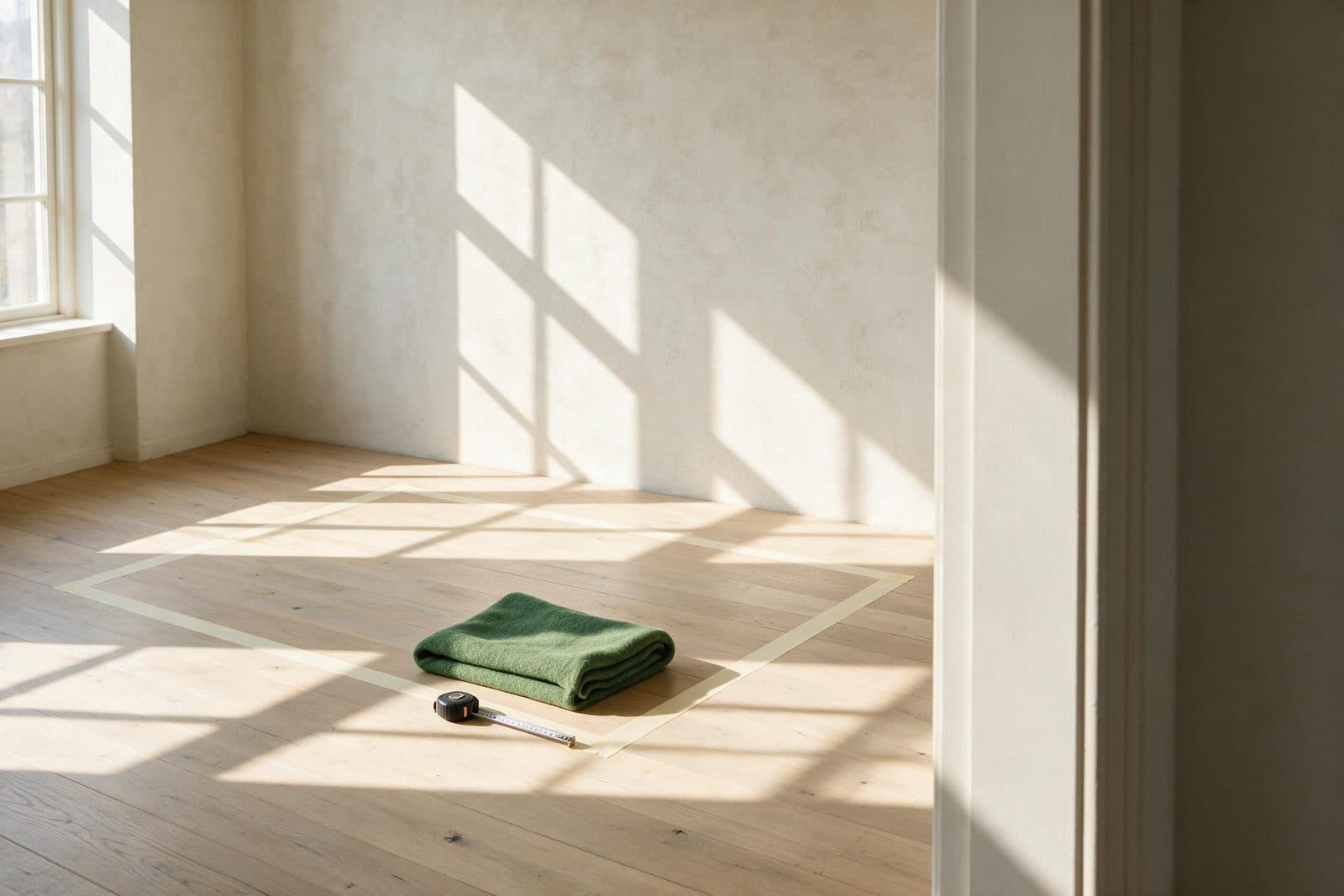
Here is the moment this article is about. You have found the sofa. It is the right color, the reviews are good, and it is on sale until Sunday. And you have no real idea whether it will fit — not just against the wall, but in the room, with space left to walk and a door that still opens all the way. The honest answer is that you can know before you spend a penny, and it takes about twenty minutes. You measure the wall, you tape the sofa's real footprint onto your floor, and you check three clearances. That is the whole test. It beats standing in the room squinting and hoping, which is how most of us have bought furniture our whole lives.
How do I know if a couch will fit in my room?
Measure three things and compare them to the sofa's listed dimensions: the wall it will sit against, the path it has to travel to get into the room, and the walking space it leaves behind. A couch fits when all three pass, not when it merely fits the wall. Most people check only the wall. That is exactly why so many sofas technically fit and still turn a living room into a waiting area you have to edge around.
Start with the wall (and don't let it touch)
Measure the clear width of the wall the sofa will sit against, at about knee height rather than along the floor. Skirting boards, radiators and window sills all steal a few centimetres higher up, and that is the height your sofa arm actually meets. Then subtract a little on purpose. A sofa shoved flat between two walls, wall to wall, looks built-in and slightly stuck. Leave five to ten centimetres of air at each end and the piece reads as chosen rather than wedged.
Write the number down. If the wall gives you 220cm of clear space, you are shopping for a sofa around 200cm wide, not 219cm.
Tape the footprint on the floor — the step everyone skips
This is the one that saves people, and almost nobody does it. Take the sofa's width and depth from the listing, and mark that exact rectangle on your floor with masking tape. Not a rough guess. The real numbers, including the depth, because depth is what quietly eats the room. A sofa that is 95cm deep juts nearly a metre into the space, and on paper that never feels like much.
Then live with the tape for a day. Walk the room. Try to reach the window. Sit where the sofa will be and see what your knees hit. I did this once with a corner sofa I was certain about, and the tape showed me it would land ten centimetres in front of a radiator I had forgotten existed. The tape is free and it does not have a return policy.
How much space do you need to walk around a sofa?
Leave 60 to 75cm for any path you walk regularly, and about 30 to 45cm between the sofa and the coffee table. Seventy-five centimetres is a comfortable main walkway where you will not turn sideways. Sixty is the tight minimum for a spot you pass through now and then. Below that, the room technically works but your body keeps registering it as cramped, even when you cannot say why. And if the sofa you are worried about is the one you already own, sitting in the wrong place, the same numbers apply: how to rearrange a room from one photo has the full clearance table and the free way to preview the move.
The coffee-table gap matters more than people expect. Too far and you cannot reach your cup without standing; too close and you bark your shins every time you get up. A hand's-length past 30cm is the sweet spot for most legs.
Once the tape passes, there's one honest way to see the actual sofa in your actual room before you order it. Fit Check drops the exact item into a photo of your room — right size, right proportion — and gives you a straight Buy or Skip verdict on whether it works. It's part of the RoomCalm paid plans, and it exists for exactly this moment: a sale ending Sunday and a measurement you're not quite sure about.
See the sofa in my room →Will the couch even get through the door?
A sofa that fits the living room but not the front door is one of the more expensive lessons in home life. Before you buy, measure the delivery path, not just the destination. The narrowest doorway, the turn at the top of the stairs, the width of the hallway where it has to pivot, the lift if there is one.
The useful trick is that a sofa can usually be tilted or stood on its end, so the number that saves you is often the diagonal of the doorway, not its plain width. Compare the door's height and diagonal against the sofa's depth and height. Many a couch that looks too wide for a doorway goes straight through once it is turned on its side. If yours genuinely will not, that is worth knowing on Saturday and not at delivery.
Why do sofas always look bigger in real life than in the listing photo?
Because listing photos are built to make furniture look good, and looking good usually means looking smaller in a larger room. Wide-angle lenses stretch the space behind the sofa. The shot is often taken in a showroom far bigger than your living room, styled with an undersized rug and props that trick your sense of scale. There is rarely a person in frame to measure against.
The one thing in the listing that does not lie is the dimensions in centimetres. Trust the number over the picture, every time. A sofa photographed to look like a two-seater can arrive with the presence of a small boat, and the giveaway was in the spec table all along. If you would rather not judge from a photo at all, there are four ways to see furniture in your room before you buy it, and which one is open to you depends almost entirely on which shop the sofa is coming from.
The sofa-to-rug ratio that makes it look right
A sofa can fit perfectly and still look wrong, and the culprit is almost always the rug. As a rule, the rug should be at least as wide as the sofa, and ideally reach about 20cm past each arm. The front legs of the sofa should sit on it. A rug that stops short of the furniture chops the floor into pieces and makes the whole arrangement look like it is floating away from itself.
This is the same scale instinct that makes a small room feel bigger or smaller than its actual square metres, and it is worth understanding before you buy anything large.
The rug rule is one of nine scale tricks that change how big a room feels — without moving a single wall.
Read: How to Make a Small Room Feel Bigger →Will a 3-seater fit in a small living room?
Often, yes, but measure before you fall in love. The two numbers that decide it are the clear wall width (aim for 200cm or more) and the walkway you can keep in front (hold onto that 75cm if you can). Where a full three-seater will not go, a loveseat or a slim-armed three-seater usually does. Sofa arms are sneaky: a chunky rolled arm can eat 20cm on each side, so two sofas listed at the same width can seat very different numbers of people. Look for the seat width, not just the overall width.
See it in your real room before you commit
Measuring tells you whether a sofa fits. It does not tell you whether it looks right — whether that color, that scale and that shape belong in your particular room, with your walls and your light. That is the part guessing gets wrong most often, and it is the part you cannot un-buy once the delivery van has gone.
Upload a photo of your living room and see it restyled around the sofa you're considering — free, no sign-up, and it keeps your real room instead of inventing a new one.
Try it on my living room →Quick answers
Will a 3-seater sofa fit in a small living room?
Often yes, as long as the wall gives you around 200cm of clear width and you can keep a 75cm walkway in front of it. If a full three-seater is too tight, a loveseat or a slim-armed three-seater usually fits the same space, since chunky arms can eat 20cm on each side.
How much space do you need to walk around a sofa?
Leave 60 to 75cm for any path you use regularly, and about 30 to 45cm between the sofa and the coffee table. Seventy-five centimetres is a comfortable main walkway; 60cm is the tight minimum for a spot you only pass through occasionally.
How do I measure my room for a couch?
Measure the clear wall width at knee height, the depth the sofa will project into the room, and the doorway and hallway it has to pass through to get there. Then mark that full rectangle on the floor with masking tape and live with it for a day before ordering.
Why does furniture look smaller online than in real life?
Listing photos use wide-angle lenses, showrooms larger than your room, and undersized props that shrink the furniture and stretch the space. The dimensions in centimetres are the only part of the listing that does not lie, so trust the number over the picture.
Will my sofa fit through the door?
Measure the narrowest doorway and any turn in the hallway or stairwell, then compare them against the sofa's depth and height rather than its width. A sofa can usually be tilted or stood on its end, so the doorway's diagonal is often the number that decides whether it gets in.