By Anas · Updated August 28, 2026 · 8 min read
How to See Furniture in Your Room Before You Buy It
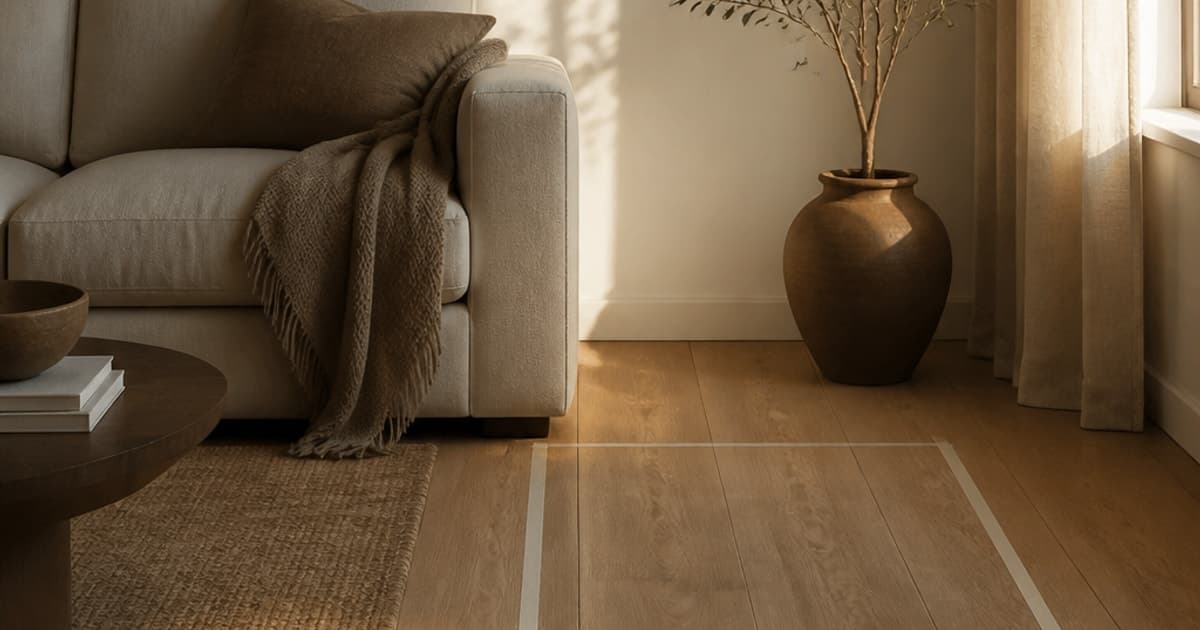
You can see furniture in your room before buying it, and there are four honest ways to do it: a store's own augmented reality app, painter's tape on the floor, a photo comparison against something you already own, or an AI tool that drops the item into a picture of your room. Which one you reach for depends almost entirely on where the furniture is coming from. That is the part nobody says out loud. The AR button on a retailer's product page is genuinely good, and it stops working the moment you shop anywhere else.
Can you actually see furniture in your room before you buy it?
Yes, and for most big retailers it takes about thirty seconds. Amazon, Wayfair, IKEA and Houzz all built the same feature into their apps: you point your phone at the floor, the app drops a 3D model of the product into the camera view at real scale, and you walk around it. Amazon charges its sellers nothing to add these models, which is why so many listings have them.
The catch is the model. Somebody has to have built a 3D version of that exact product, and only the retailer selling it has a reason to. So the feature is superb inside one shop and useless across the whole rest of the market, which is where a lot of furniture actually gets bought.
What apps let you see furniture in your room?
The four you will run into are IKEA Place, Houzz View in My Room 3D, Wayfair View in Room 3D and Amazon View in Your Room. All four are free, all four are locked to their own inventory, and they differ mainly in how much of that inventory has a model behind it.
| Tool | What it can place | Works with items from anywhere else | Cost |
|---|---|---|---|
| IKEA Place | IKEA products. Launched in 2017 with more than 2,000, mostly large living-room pieces | No | Free |
| Houzz View in My Room 3D | Houzz listings. Passed one million furniture, decor and remodeling products in March 2018 | No | Free |
| Wayfair View in Room 3D | The subset of Wayfair's catalogue that has a 3D model. Wayfair lists more than 14 million items overall | No | Free |
| Amazon View in Your Room | Listings where the seller uploaded a model. Supports furniture, decor and wall-mounted items, not clothing, shoes, eyewear or ceiling fittings | No | Free |
| Painter's tape on the floor | Anything you have the dimensions for | Yes | Free |
| An AI room tool | Anything you have a photo of, including a secondhand listing | Yes | Varies |
Does IKEA Place work with furniture that is not from IKEA?
No. IKEA Place places IKEA products only, and the same is true of every store app in the table above. This is not a flaw so much as the entire business model. A retailer pays to have 3D models made because those models sell that retailer's products, and there is no commercial reason for IKEA to model a sofa from a shop down the road.
It matters more than it sounds. If you are comparing a Wayfair sectional against a West Elm one against something from a local showroom, you cannot see them side by side in your own living room, because each lives in a separate walled app. You end up doing the comparison in your head, from photographs, which is exactly the situation the AR was supposed to rescue you from.
How accurate is AR furniture placement?
Accurate on size, unreliable on light. IKEA says the technology behind IKEA Place scales furniture to 98 percent accuracy, and in practice the footprint you see on your floor is close enough to trust. Houzz reports that two million people have used AR while shopping in its app, and that people who used the tool were eleven times more likely to buy, which is Houzz's own figure but a telling one.
Where AR quietly misleads you is colour and material. The renderer lights the model with its own assumptions, not with the north-facing window that makes everything in your room read cooler and greyer than it does in the showroom. A sofa can be the right size in AR and still turn up the wrong shade of oatmeal. Trust the footprint. Do not trust the fabric.
How do I see a secondhand couch in my room?
No AR app will help you, because nobody has ever built a 3D model of one stranger's used sofa. This is the single biggest hole in the whole category, and it covers Facebook Marketplace, Craigslist, eBay, estate sales, thrift shops and the piece your aunt is giving away.
What you have instead is a photograph, usually a bad one taken in someone's dim garage, and a seller who may or may not know the measurements. So you do it in two steps. First, get real numbers: ask the seller to measure width, depth and height, or measure a known object in their photo and scale from it. Second, put those numbers on your floor with tape before you drive anywhere. A secondhand bargain you have to re-sell is not a bargain.
Marketplace has its own set of rules: what to ask before you go, what a fair price looks like, and the questions that flush out a broken frame.
Read: Buying furniture on Facebook Marketplace →Is there a free way to see furniture in my room without downloading an app?
Painter's tape, and it is still the method I trust most. Take the listed width and depth, mark that exact rectangle on your floor, and leave it there for a day. It costs about three dollars a roll, it works with any item from any shop or any stranger's garage, and it is the only method that puts the furniture in the path your body actually walks.
Add height with a cardboard box or a stack of books at the back corner, because depth and height are what people misjudge. A bookcase that is fine on paper can block a light switch or crowd a doorway in a way no floor rectangle reveals. The tape will not tell you whether the piece looks right, but it will tell you whether the room still works, and that is the more expensive mistake.
Why does the furniture look the wrong size in photos?
Because listing photos are staged to flatter the product, and flattering a sofa means shrinking it. Wide-angle lenses stretch the wall behind it. The room in the shot is usually bigger than yours. Rugs and lamps are often undersized props chosen to make the furniture look generous, and there is rarely a person in frame to give your eye a reference.
The fix is to find something in the photo you own too. A standard interior door, a dining chair, a laptop. Measure yours, then use it as a ruler against the picture. It is rough, and it is still far better than judging by feel. The numbers in the spec table are the only part of a listing that has no incentive to lie to you.
How much space do I need to leave around it?
Leave 60 to 75cm for any walkway you use regularly, and 30 to 45cm between a sofa and its coffee table. Those come from the same published clearance conventions a paid designer works to, and they are the reason a room can pass the tape test and still feel wrong. A piece that fits the wall but eats the walkway will annoy you every day for years without you ever naming why.
The other numbers worth knowing while you are shopping: a rug should reach about 20cm past each sofa arm, art hangs with its centre near 57 inches, and a living space wants roughly 20 lumens per square foot of ambient light against about 50 on a work surface. Buy the sofa against the clearances, not against the wall.
We publish the whole rulebook we apply, with its real sources: the NKBA clearances, the lighting math, the 57-inch rule, LRV and 60-30-10.
See the method →What if I want to know whether it looks right, not just whether it fits?
That is a different question and it is the one that costs people money. Fit is arithmetic. Whether a piece belongs in your room is about its colour against your walls, its scale against what you already own, and the light you actually get. The National Retail Federation projected 890 billion dollars of retail returns in 2024, and in furniture the size-and-colour mismatch is the usual reason a thing goes back.
This is what RoomCalm's Fit Check is for. You upload a photo of your room and the item's listing photo, and it shows the piece in your actual room with a size check reasoned against your real furniture, then gives you a straight verdict. It works from any photo, so a Marketplace couch and a thrift-store dresser go through the same way an Amazon listing does. It is honestly a paid feature, part of the RoomCalm plans, with a 14-day money-back guarantee and a fair-use limit of ten checks a day.
See the exact item in your actual room, at the right scale, with a Buy or Skip verdict. Part of the paid plans, which start at $9 one-time.
Try Fit Check →What order should I do all this in?
Cheapest checks first, because each one kills a bad idea before you spend anything on the next.
- Get the real dimensions, from the spec table or from the seller. Never from the photo.
- Tape the footprint on the floor and live with it for a day. Free, and it catches the radiator you forgot about.
- Check the delivery path: narrowest doorway, the turn at the top of the stairs, the lift.
- Check the clearances: 60 to 75cm of walkway, 30 to 45cm to the coffee table.
- If the retailer has AR, use it for the footprint, and ignore what it tells you about the colour.
- If the piece is secondhand, or you want to know how it looks rather than whether it fits, put it in a photo of your room before you commit.
Free and no sign-up: upload a photo and see your real room redesigned around what you already own, before you buy anything else.
See my room redesigned free →The measuring half of this, in full: the wall, the doorway diagonal, and the three clearances a sofa has to pass.
Read: Will this couch fit in my room? →Quick answers
Can I see furniture in my room before buying it?
Yes. Amazon, Wayfair, IKEA and Houzz all have free augmented reality features that place a 3D model of their own products into your camera view at real scale. For anything outside those catalogues, tape the footprint on your floor or use an AI tool that drops the item into a photo of your room.
What is the best app to see furniture in your room?
There is no single best one, because each app only works with its own shop. IKEA Place is the most polished, Houzz has the largest library at over a million products, and Amazon's View in Your Room covers whichever listings have a seller-uploaded model. Pick the app belonging to the shop you are buying from.
How do I see a secondhand couch in my room?
No AR app can help, because nobody builds 3D models of used furniture. Get the real width, depth and height from the seller, tape that rectangle onto your floor, and if you want to see how it looks rather than whether it fits, put its listing photo and a photo of your room into a tool that composites the two.
How accurate are AR furniture apps?
Accurate on size and unreliable on colour. IKEA states that IKEA Place scales products with 98 percent accuracy, and the footprint is generally trustworthy. The lighting is rendered with the app's assumptions rather than your room's real daylight, so fabric shades and wood tones often arrive looking different.
Is there a free way to visualize furniture in my room?
Painter's tape is free, works with any item from any source, and is the only method that puts the furniture into the path you actually walk. Mark the exact width and depth on your floor, add height with a cardboard box, and live with it for a day before ordering.